Diverse intelligences, alien intelligences
Last Wednesday (2026-05-06) I gave a short presentation at DIVSOL, the Diversity in Society and Life research community at the University of Helsinki. In the talk I explain how the research I’ve done over the past decade or so relates to the general theme of diversity in science and society.
Here’s how I got into diversity research. I remember the moment quite vividly: in November 2013 I was in my kitchen watching a Coursera video by Scott Page, an economics professor at Michigan University.
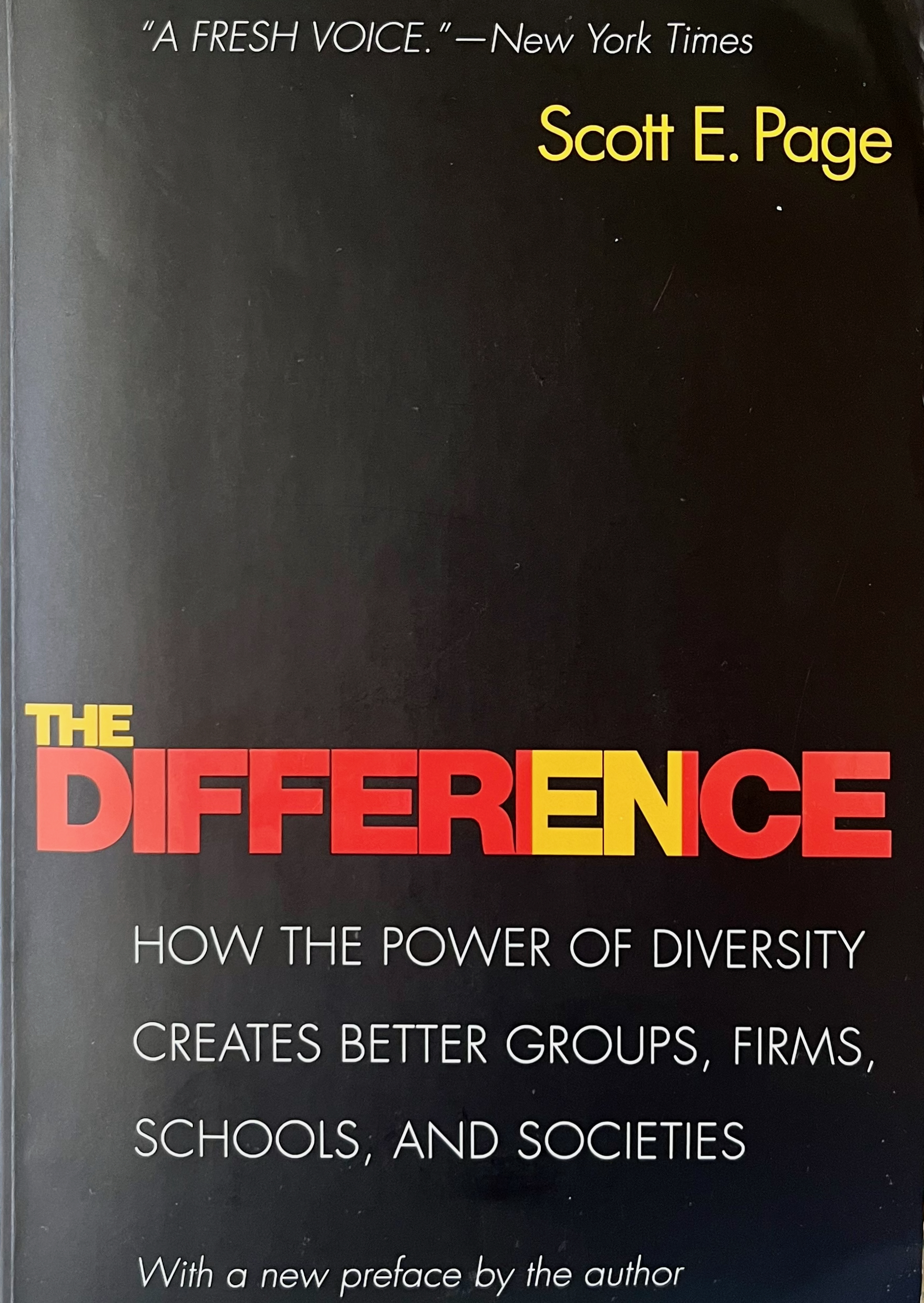
In that video, Page was presenting his (and his coauthor’s) famous finding from 2004, the diversity trumps ability theorem. The upshot of the theorem is that when people solve problems together, in groups, it makes sense to maximize the diversity of the group members instead of building the group from the individually best performers. This finding has later had lots of implications e.g. for hiring, when companies started following it in recruiting (McKinsey 2015). (But for some of the rather depressing recent developments, see here)
I thought that was really interesting, and started thinking about what such results would mean in my own research field, philosophy of science.
Ever since Thomas Kuhn’s Structure of Scientific Revolutions in the 1960s, philosophy had had a discussion about the role of rationality in science. Paul Feyerabend had suggested a very radical diversity thesis: “anything goes”, i.e. there is no scientific method, and we should let all flowers bloom. No theory should be permanently discarded, because later on, it may turn out the be true, after all.
How diversity works in research
Others were more cautious. For example in the 1990s, Philip Kitcher argued that no departures from rationality were needed, but instead, a beneficial division of labor between scientists would be enough to get to good collective outcomes.
Using modeling techniques from biology and economics, Kitcher’s paper launched a new field, which could be called social epistemology of science, and that’s the field that I’ve been working in since that afternoon in 2013 (O’Connor 2023, Šešelja 2023).
Here’s the agenda of the field (in the words of Steve Fuller, 1988):
“How should the pursuit of knowledge be organized, given that (…) knowledge is pursued by many human beings, each working on a more or less well-defined body of knowledge and each equipped with roughly the same imperfect cognitive capacities, albeit with varying degrees of access to one another’s activities?”
But how is this related to diversity? I should clarify some of the central concepts I’m talking about.
My main interest has been in cognitive diversity: We say that a group is cognitively diverse when its members differ, for example, with respect to their disciplinary background, expertise and skills, problem-solving heuristics, or strategy that each group member uses to explore a common field of research.
Cognitive diversity can be distinguished from demographic diversity (its members occupying different social locations, e.g., with respect to gender, class, ethnic identity, nationality, and race), and from social value diversity (when its members endorse different social and political values, or act as representatives of different interest groups). More on these concepts in Rolin et al. 2023.
All these kinds of diversity can be understood as being intrinsically valuable, but what both Page and Kitcher are trying to articulate is the indirect benefit to science of having more diversity in the workforce.
(In political philosophy, a similar case has recently been made for democratic decision making, most forcefully by Helene Landemore.)
Cognitive diversity was of the key concepts of my 2020-2025 Academy fellow project called Modeling the republic of science. Obviously there is no one way that diversity works in science. You could say it has several functions, and these functions are served by different mechanisms.
| # | Function | Mechanism(s) |
|---|---|---|
| 1 | Epistemic justice / inclusion | Giving everyone a voice |
| 2 | Expanding the scientific workforce / not wasting talent | Unbiased recruitment of candidates |
| 3 | Cognitive coordination | Balancing exploration vs. exploitation; Collective memory |
| 4 | Prediction accuracy | Wisdom of crowds; Condorcet jury process |
| 5 | Error correction / bias removal | Adversarial intellectual interaction (Longino 1990) |
| 6 | Accuracy in theory choice | Avoiding premature convergence in evidence generation (Zollman 2010) |
| 7 | Promoting discovery/creativity in problem solving | DAB mechanisms (Hong & Page 2004) |
| 8 | Resilience under turbulence/change | Availability of second-best options |
The table is far from exhaustive, and does not include the potential downsides or costs of diversity to research. Here I just want to point out one thing (Row 5): Philosophers don’t agree about most things, but in philosophy of science there’s almost a universal consensus that scientific knowledge cannot be found in the brain of any particular scientist. Instead, scientific knowledge is collectively held by the scientific community. Furthermore as feminist philosopher of science Helen Longino (1990) famously argued, the objectivity of that knowledge is guaranteed by critical exchange of arguments among a diverse community of scientists.
Cognitively diverse university
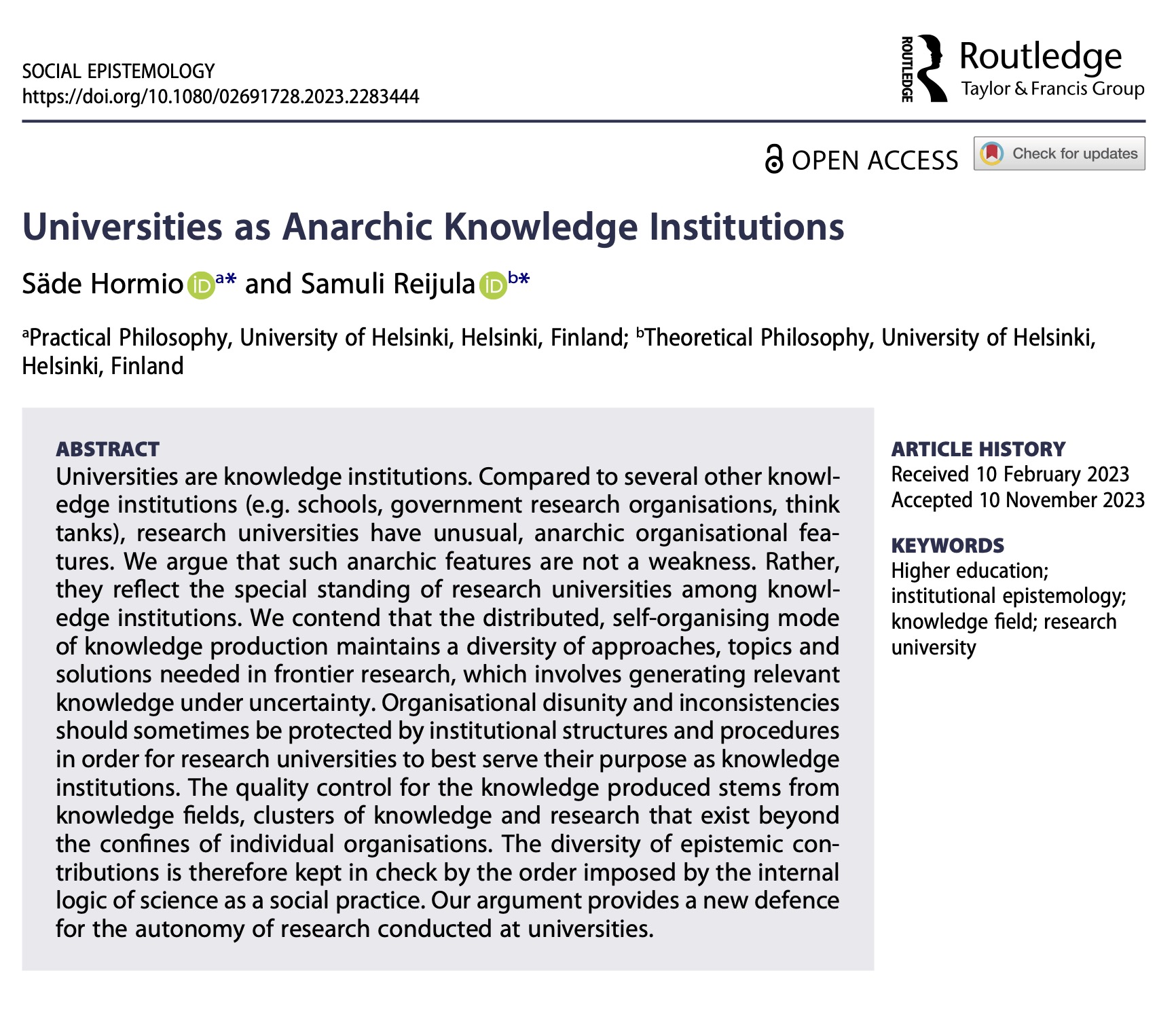
In 2023 my colleague Säde Hormio and I took some of these ideas and applied them to higher-education research. Based on diversity arguments, we put forward a new argument for academic freedom: Namely, that the capacity of universities to serve the society by discovering significant truths depends on us having sufficiently diverse repertoires of (1) problems we study , (2) solutions we develop, and (3) people thinking about the world in different ways.
Alien intelligences and existential implications
Here’s what I’m doing now (2026-05). I have a new research project starting on June 1st, 2026: Scientist in the loop - Automation of scientific discovery (SCI-AI) is funded by an ERC Consolidator grant. The main aim of the project is to better understand how AI is changing scientific discovery.
In terms of methods and theory, SCI-AI continues what I did before in my study of collective problem solving in science. But now the question, from the diversity viewpoint, is what is happening to science now when these alien intelligences are entering academic research.
Not everyone likes that framing, and I understand why. I myself have mixed feelings about the AI transition. But I think it’s a real thing, the models are quite capable, and the benefits to advancement science can be really big. That said, risks and downsides are just as real.
I recently read this Terence Tao interview, and I agree with him that AI will change research in almost all scientific fields. But I feel strong nostalgia for pre-AI times. Many of the research skills that I spent decades learning are quickly losing value. If I could turn back the clock, I’d be perfectly happy doing my research in those pre-AI times. I’m one of those, mentioned by Tao, going through the five stages of grief.

SCI-AI hasn’t really started yet, but one thing I want to mention is this idea that AI can be a useful reminder to us humans of our own limitations. In this paper that I wrote together with Renne Pesonen from Tampere University, we argue that based on scientific findings (and conceptualizations) alone, there are no in-principle reasons why machines could not be intelligent, creative, or genuinely understand language.
Most of us have intuitions to the contrary, and I’m sure that the view we outline is not a popular one. But we hope it’s a discussion opener. I think that from the diversity point of view, AIs, these alien intelligences, provide us humans an opportunity to look in the mirror, and understand our own humanity more clearly. We’ve actually had superhuman cognitive capacities around for a long time (e.g. pocket calculators with their amazing capacity to multiply large numbers), but the fact that LLMs cracked at least the syntax problem for natural language really rubs the point in our face. We argue that whether impressive feats of LLMs mean that they are “really” intelligent or not isn’t all that relevant. What matters more, from an existential point of view, is that they offer us humans an opportunity to develop some epistemic humility, that is, the capacity to see both our intellectual strengths and weaknesses more clearly.
Thinking meat, crazy, right? (Terry Bisson 1991, worth checking out …)
(Cross-posted to leaflet.pub)