Samuli Reijula
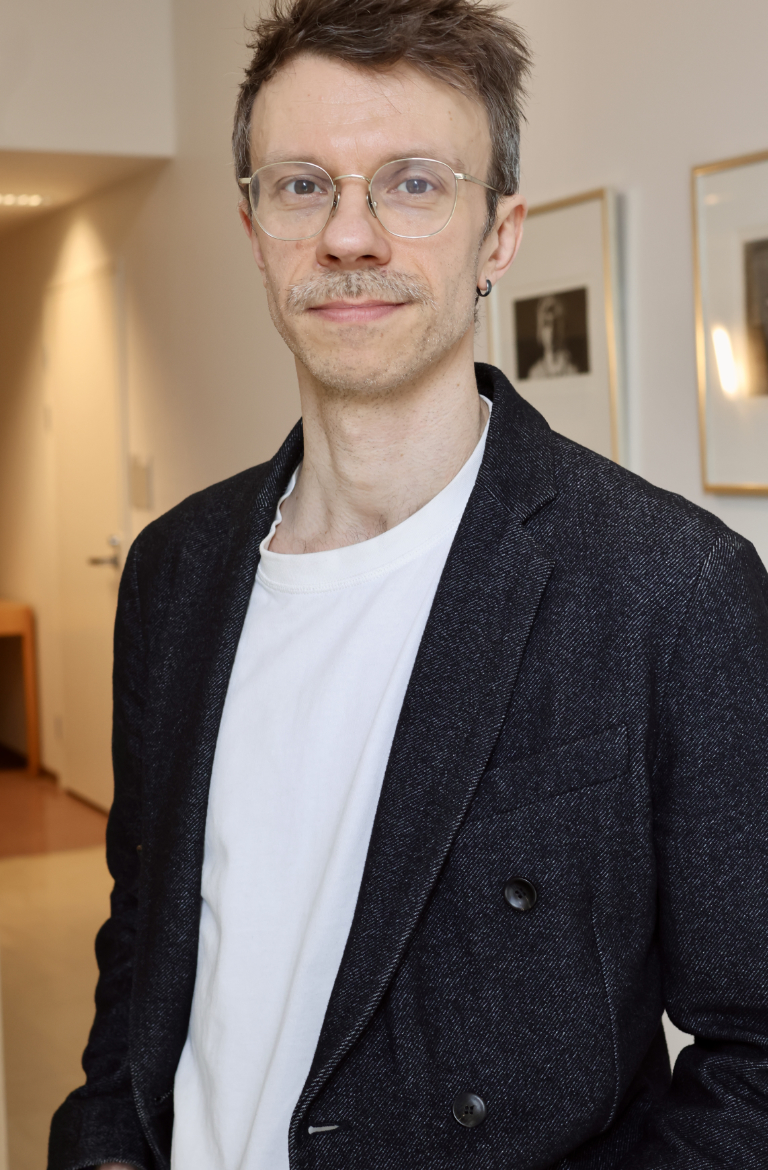
I am a philosopher and cognitive scientist interested in how science works, how it could, and how it should work.
I work as an Associate Professor in Theoretical Philosophy at the University of Helsinki. My research is currently funded by the ERC Consolidator grant Scientist in the loop - Automation of scientific discovery (SCI-AI).
The general aim of my research is to better understand scientific problem-solving: Science is the humanity’s most successful problem-solving system, and the primary source of epistemic authority in modern societies.
I view & model science as a distributed cognitive system, “problem-solving writ large.” How does that system function at different levels of analysis ranging from individual scientists to research groups and scientific communities?
And how should it function - what are the social, cognitive, and institutional preconditions of well-functioning scientific research?
-
The allure of pseudoscience
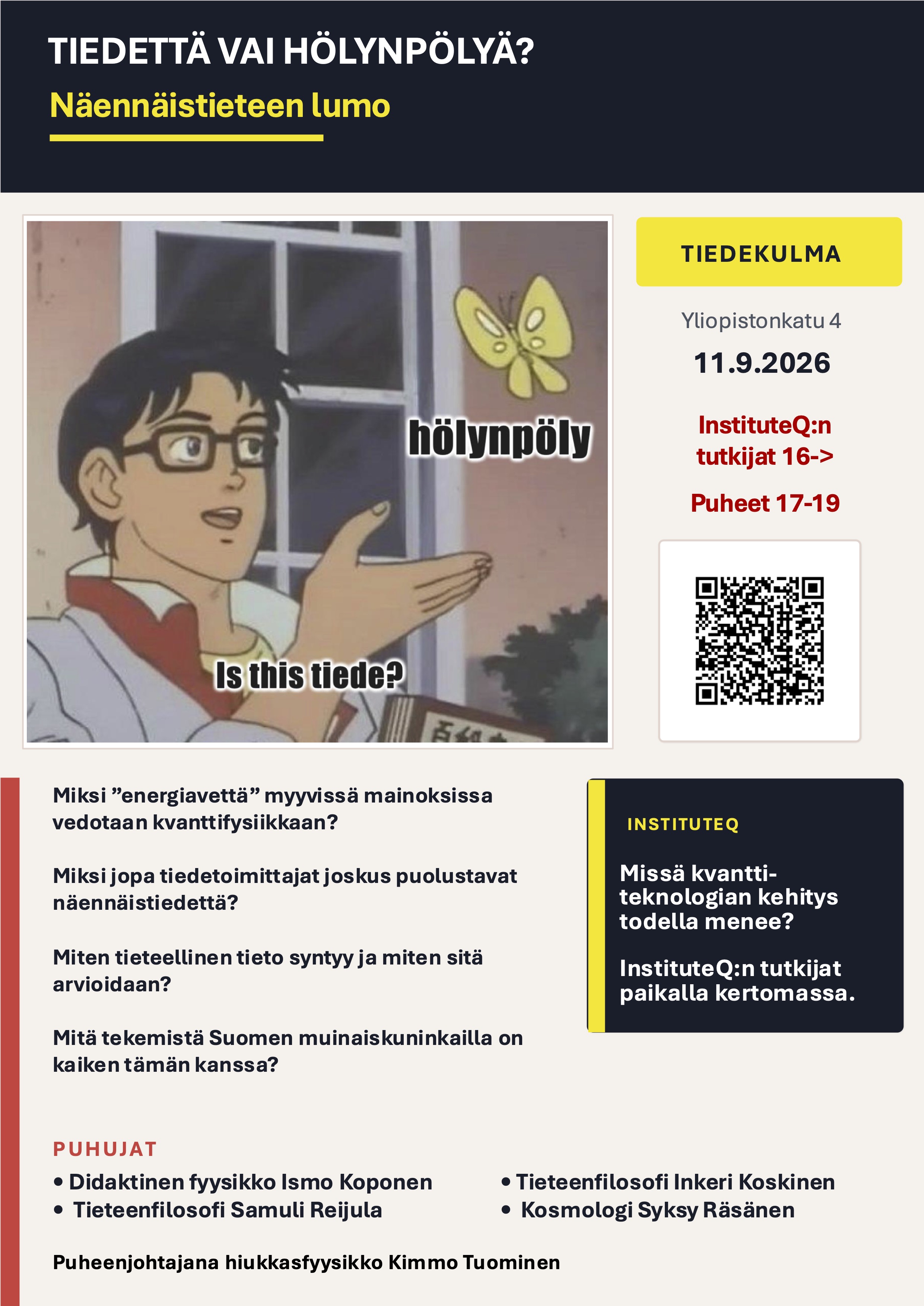
Here’s a link to a video of a Tiedekulma event on Friday, September 11, 2026. The event was titled “Tiedettä vai hölynpölyä - näennäistieteen lumo.” Four talks by two physicists (Ismo Koponen and Syksy Räsänen) and two philosophers of science (Inkeri Koskinen and me). The video stream cuts off after 2h, but we stayed in Tiedekulma for another hour until they switched off the lights and basically had to drag us out.
Organized by InstituteQ and Kimmo Tuominen
-
Consciousness, Creativity, and Understanding Are not Obstacles to Machine Intelligence forthcoming in Synthese
Helsingin Sanomat recently interviewed me about AI, and we ended up talking about what AI teaches us about human intelligence.
Some of the thinking behind those quotes can be found here, and a recently accepted research article (in English) here.
-
Emergence of Computational Social Science published in Quantitative Science Studies
I happened to check the latest issue of Quantitative Science Studies and was happy to see that our paper The emergence of computational social science: Intellectual integration or persistent fragmentation? has been published. We (Juho Pääkkönen, Matti Nelimarkka, and I) had been working on this project for several years, on and off, so great to see it’s out there, finally. And it’s open access
-
Diverse intelligences, alien intelligences
Last Wednesday (2026-05-06) I gave a short presentation at DIVSOL, the Diversity in Society and Life research community at the University of Helsinki. In the talk I explain how the research I’ve done over the past decade or so relates to the general theme of diversity in science and society.
-
Objectivity is misunderstood in new academic recruitment policies
In a short article recently published in Tietessä Tapahtuu, a science-policy journal, Jaakko Kuorikoski and I argue that two policies recently introduced in Finnish higher education compromise academic autonomy.
These policies outsource researcher evaluation to extra-academic agents, and result in absurd demands on academic review panels. If implemented, they can lead to significant harm to the quality of Finnish research and self-regulation of the academic community.
-
Interviewed by The Reasoner
Lorenzo Casini from The Reasoner recently interviewed Dunja Seselja, Matteo Michelini and me on agent-based modeling in the philosophy of science and social epistemology. Dunja has organized this amazing series of workshops called Simulations of Scientific Inquiry, and Lorenzo joined us as one of the keynote speakers at the latest workshop.
Here’s the link to the interview.
“If I had to pick one hypothesis to be tested in a real-world setting, I’d go with my work on bias and laziness” - says Matteo. Better find out what he’s talking about!
-
Perspective on diversity in Mustread
My short perspective piece on the value of diversity and DEI policies was just published in Mustread. This one is in Finnish.
A manuscript version here
-
Opinion. Inheritance tax debate needs attention on values (HS)
A short opinion piece in Helsingin Sanomat on inheritance tax, with Säde Hormio
-
Opinion. Public authorities should leave X (SK)
My opinion piece “Public authorities should leave X” published in Suomen Kuvalehti.
-
Unpopular ideas on AI and epistemic humility
In this preprint Renne Pesonen and I argue that often arguments against machine intelligence are actually motivated by intuitions against machine agency.
In our view, the striking thing about LLMs is that they are an existence proof of structurally simple (but large!) systems that can perform many of the tasks we think require intelligence. The fact that they might do those things in a “wrong”, non-human, way is beside the point: Something we thought could only be brought about by the (so far) unexplained powers of the human mind is now done by a shallow system. This should give us pause, some epistemic humility and antidote to human cognitive exceptionalism.
-
Why we all should care about the Fediverse
(This post started out as a fediverse reading list on 2024-09-30. It’s still an unfinished notebook where I try to figure out why I think fediverse matters)
I’ve become increasingly interested in the fediverse. Thinking in terms of protocols instead of privately owned platforms could give us ways to address some of the epistemic challenges associated with the new AI-structured information landscape. My plan is to write something on this later on, but I’ll start by gradually compiling a reading list on both technical and more conceptual thinking on the fediverse. I’ve been asking people for recommendations on what to read.
-
Interview in Paatos (w/ Kristina Rolin and Jaakko Kuorikoski)
The philosophical magazine Paatos published an interview with three philosophers of science, Kristina Rolin, Jaakko Kuorikoski and me. The format is interesting - Jere Hallikainen, the author, added some links and references but otherwise the transcript follows the discussion very closely. Thanks Jere!
Turns out that surprisingly many philosophers started out as engineers. Or aspiring professional musicians!
-
Visiting CMU in October-November 2024
In October-November 2024 I will be visiting the Center for Formal Epistemology and the Institute for Complex Social Dynamics at Carnegie Mellon University (hosted by Kevin Zollman). Really looking forward to this!
-
On the idea of Bildung university
This week I gave a short presentation on the idea of Bildung university (‘sivistysyliopisto’ in Finnish). The notion of Bildung doesn’t quite translate to English but we have a word for it in Finnish, ‘sivistys’. Here Bildung university refers to the modern concept of research university from early 19th century, first embodied by the University of Berlin (founded in 1810).
It’s a lofty ideal and many of the ideas behind it come from German enlightenment and neohumanism: Kant, Fichte, Schelling, Schleiermacher - and Humboldt. Although it seems like a politically implausible picture of autonomous universities and academic freedom, incompatible with current managerialist trends in higher education, the Bildung university model has been remarkably resilient, and successful. Despite various pressures and mutations along the way, it still lies at the heart of our best research universities, not only in continental Europe but also in the US, where the German model was exported during the 19th century.
-
Interview - Science, uncertainty and trust
Amanda Häkkinen (TSV) interviewed me about my research for a series on open science. We talked about scientific problem solving, Heidegger, uncertainty and trust. And other things. Here, (in Finnish).
-
AI as a mirror for human intelligence
Inspired by dinner debates around New Year’s (2023), Renne Pesonen and I wrote an essay (in Finnish) on large language models.
-
Encyclopedia entry on the philosophy of science
Tomi Kokkonen and I wrote a (long!) entry on the philosophy of science for the Logos encyclopedia. It’s in Finnish, but who cares in this age of chatGPT.
Tweets here.
-
Workshop materials - Agent-based models in social epistemology
Materials from the computational methods workshop at the 2022 Summer school of the Vienna doctoral school of philosophy, finally on github.
-
On positionality statements (In Finnish)
I talked to a journalist from Helsingin Sanomat about positionality statements in science (here). My email response turned into a micro essay, so I’ll post it here.
-
Interview on basic research (in Finnish)
I, among several other researchers, was recently interviewed by the magazine Tekniikan Maailma about the importance of basic research. Here
-
reijulab
Ok ok I know it’s silly. One man research lab. But my personal research section is called Reijulab from now on. Why? Why not!
-
Diversity-ability-trade-off (@Philosophy of Science)
With Jaakko Kuorikoski, I have a new paper coming out in the Philosophy of Science (PSA2020/2021 proceedings). The paper examines the diversity-beats-ability theorem originally put forward by Lu Hong and Scott Page, 2004.
Long story short, (1) we don’t think the original model provides reliable evidence of diversity beating ability in group problem solving, but (2) we have an improved version of the model that can tell us something of interest about the trade-off between diversity and ability!
-
Institutional epistemology
Here’s a link to a paper I wrote with Petri Ylikoski, where we outline the idea of institutional epistemology. (in Finnish!)
-
New project - modeling the republic of science
I’m on research leave 2020-2025, working on my personal research project funded by the Academy of Finland. The project is called “Modeling the republic of science: Collaborative problem solving and collective rationality in scientific inquiry”
-
Self-nudging in media
Our self-nudging article is getting some attention in media: Behavioral scientist, Yliopisto-lehti, The Decision Lab, NBC Today (9/2020)
-
Use of modeling for policy decisions @Alusta
Jaakko Kuorikoski and me wrote a small contribution to the debate on the use of evidence and computational models at the times of pandemic (in Finnish). In Alusta!
-
Models as argumentative devices (@Synthese)
How can philosophers make use of (simulation) models? Together with Emrah Aydinonat and Petri Ylikoski (Synthese, forthcoming 2020), I argue that e.g. in social epistemology (of science), models should be understood as argumentative devices, and their epistemic status be evaluated accordingly.